
Existential and Opaque Types in Swift
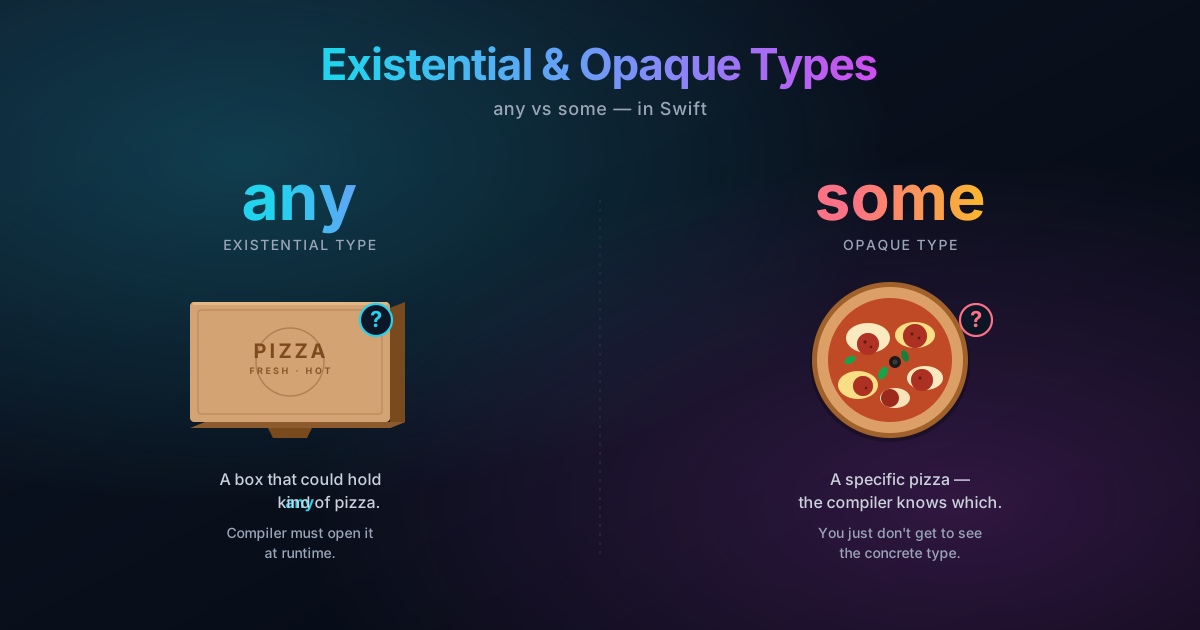
any and some are two of the more frequently squinted-at keywords in modern Swift. They look interchangeable. They are not. This is a written-up version of a talk I gave on the difference, with the pizza analogy intact, because who doesn't love pizza.
A couple of pre-requisites: a working idea of what protocols and generics are. Good? Good.
The two terms
An existential type is, roughly: "any type, but conforming to protocol X." In Swift it's spelled any X.
An opaque type is, roughly: "the expected type, without naming a concrete one." In Swift it's spelled some X.
Those two definitions sound almost identical when you read them quickly. The difference is in what the compiler does with each one. And that has real consequences for performance, for what code you can write, and for what the compiler will and won't let you do.
Let's set up the example.
A pizza protocol
protocol Pizza {
    var name: String { get }
    var size: Int { get }
}
Imagine a function that takes a pizza:
func receivePizza(_ pizza: Pizza) {
    print("Yum, I love \(pizza.name).")
}
When this function is called, pizza is what's known as a box type, an existential container. To get to the name property, Swift has to open the box at runtime, find the concrete object inside that conforms to Pizza, and then read name off it.
That's not free. Existentials defeat most compile-time optimisation. The function does what you'd expect, but it's more expensive than it could be.
Now look at this:
func receivePizza<P: Pizza>(_ pizza: P) {
    print("Yum, I love \(pizza.name).")
}
Almost identical at a glance. Completely different in what's actually happening. Here Pizza isn't being used as a type. It's a constraint on the generic parameter P. The compiler resolves P at compile time, so receivePizza ends up receiving a concrete instance of a known type. No box. No runtime opening.
This is the part of Swift that bites people: those two function signatures look like they do the same thing. They don't.
Enter any
Because the difference between "type" and "constraint" was so easy to miss, the Swift team introduced the any keyword. It doesn't add new functionality; it just forces you to say "this is an existential":
func receivePizza(_ pizza: any Pizza) {
    print("Yum, I love \(pizza.name).")
}
The generic version (<P: Pizza>) doesn't need any, because in that version Pizza is being used as a constraint, not as an existential.
You're probably already using any without writing it:
// These two are the same:
func receivePizza(_ pizza: Pizza) { … }
func receivePizza(_ pizza: any Pizza) { … }
The compiler currently fills it in for you. In the near future it'll be enforced, so you may as well start writing any now and be honest about what your code is doing.
Where does some come in?
Look at the generic version again:
func receivePizza<P: Pizza>(_ pizza: P) {
    print("Yum, I love \(pizza.name).")
}
We declared P only because the function signature needs something to refer to the type by. We don't actually use P for anything else. some lets us drop that ceremony:
func receivePizza(_ pizza: some Pizza) {
    print("Yum, I love \(pizza.name).")
}
Read this as "this function takes some Pizza" rather than "this function takes some Pizza that we will call P." Functionally equivalent to the generic version. The compiler still resolves the underlying type at compile time and still optimises for it. It's just easier to write.
some is, essentially, syntactic sugar for a single-use generic parameter.
The mental picture
If your eyes are glazing over, the talk had a slide that helps. (You're looking at a version of it at the top of this post.)
any Pizzais a closed pizza box. The label says "pizza". You don't know which kind. To find out, you (or the runtime) have to open the box. The box can hold a pepperoni, a margherita, a hawaiian. Any pizza that conforms to thePizzaprotocol.some Pizzais one specific pizza. The compiler knows exactly which one (it can be a pepperoni, just one specific pepperoni) and it can optimise around that. You, as the caller, just know that what came back is "some pizza." The concrete type is hidden from you, but it's not hidden from the compiler.
That second point matters. some isn't "the compiler doesn't know either." some is "the compiler knows; you don't need to."
A rule of thumb
Prefer
some(or generics) overany, whenever you can.
Most of the time you don't actually want a box that conforms to a protocol; you want the object that conforms to the protocol. any exists for the cases where you genuinely need the box (heterogeneous collections, dynamic dispatch through a stored property, that kind of thing). For everything else, some is cheaper and more honest about your intent.
Where the rule bends: storing things
Take a MusicPlayer that needs an AudioService:
protocol AudioService {}

class MusicPlayer {
    private let audioService: AudioService

    init(audioService: AudioService) {
        self.audioService = audioService
    }
}
Per our rule of thumb, we'd reach for some:
class MusicPlayer {
    private let audioService: some AudioService   // ❌

    init(audioService: some AudioService) {       // ❌
        self.audioService = audioService
    }
}
But the compiler isn't having it:
Property declares an opaque return type, but has no initialiser expression from which to infer an underlying type.
some on a stored property is opaque-return-type territory, and it needs to be backed by a single, statically-known underlying type. init taking some AudioService is a different some from audioService: some AudioService on the property. They don't match.
The fix is to mix them:
class MusicPlayer {
    private let audioService: any AudioService

    init(audioService: some AudioService) {
        self.audioService = audioService
    }
}
The init takes some AudioService. The caller gets the cheap, statically-resolved version. We then store it as any AudioService, accepting the box on the inside because we genuinely need to hold it across method calls without committing the property to one specific concrete type.
This pattern (some on the way in, any on the way to storage) is one of the most useful "in practice" rules in this whole topic.
Pop quiz
The talk had two of these. They're worth doing in your head before reading the answer.
One
var pizza: some Pizza = PepperoniPizza(size: 1)
pizza = HawaiianPizza(size: 1)
Compiles?
❌ No. The first line tells the compiler: "the underlying type of
pizzaisPepperoniPizza." The second line then tries to assign aHawaiianPizzato asome Pizzawhose underlying type is locked in asPepperoniPizza. Different concrete type, doesn't fit.
Two
let pizzas: [any Pizza] = [
    PepperoniPizza(size: 1),
    HawaiianPizza(size: 1)
]
let pizzas: [some Pizza] = [
    PepperoniPizza(size: 1),
    HawaiianPizza(size: 1)
]
Which compiles?
✅ The
[any Pizza]one. The compiler only checks that each element conforms toPizza; the array can mix concrete types because each element is a box. ❌ The[some Pizza]one fails.some Pizzacollapses to one underlying type at compile time. The compiler can't pick betweenPepperoniPizzaandHawaiianPizza, and it'll tell you so with a "conflicting arguments to generic parameter" error.
This is the cleanest illustration of the difference. any lets you have a heterogeneous collection because every box is the same kind of box, regardless of what's inside. some doesn't, because the whole point of some is that the underlying type is one thing, just hidden.
TL;DR
any X: existential. A box. Could be anything that conforms toX. Cheap to write, more expensive at runtime.some X: opaque. One specific concrete type that conforms toX. The compiler knows it; you don't need to. Cheap at runtime.- Prefer
some(or a generic) overanyby default. - For stored properties that need to hold a protocol-conforming thing across the lifetime of the object, you'll usually end up with
someon the init parameter andanyon the stored property.
Going deeper
If you want to see what the compiler is actually doing under the hood with any and some, there's a great deck by freddi that walks through it. Worth your time if this kind of thing fascinates you, and if you've made it this far, it probably does.